
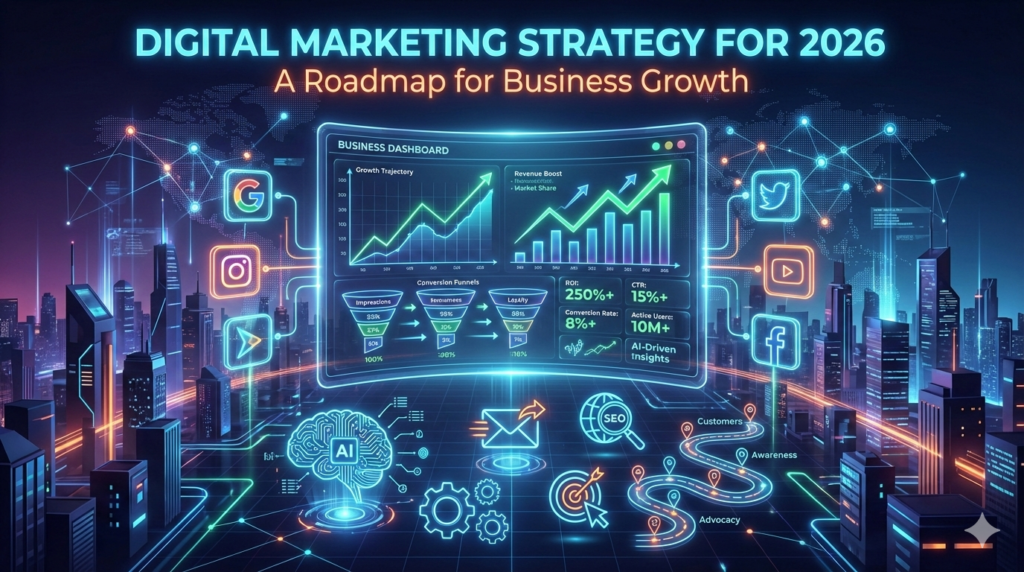
The Digital World is changing very quickly. The strategies that worked in 2022 or even 2024 may not work in 2026. Artificial intelligence is used, data privacy rules are becoming strict across the world, and customers expect better experiences from brands. Because of this, businesses need to change how they do digital marketing. In 2026, success will not be only about being visible online. It will be about building trust, offering personalized experiences, delivering real value, and creating long-term relationships with customers.
Whether you are a startup, a growing brand, or an established enterprise targeting customers across continents, this guide will help you understand how to build a future-ready digital marketing strategy that works globally.
How Digital Marketing Will Transform by 2026
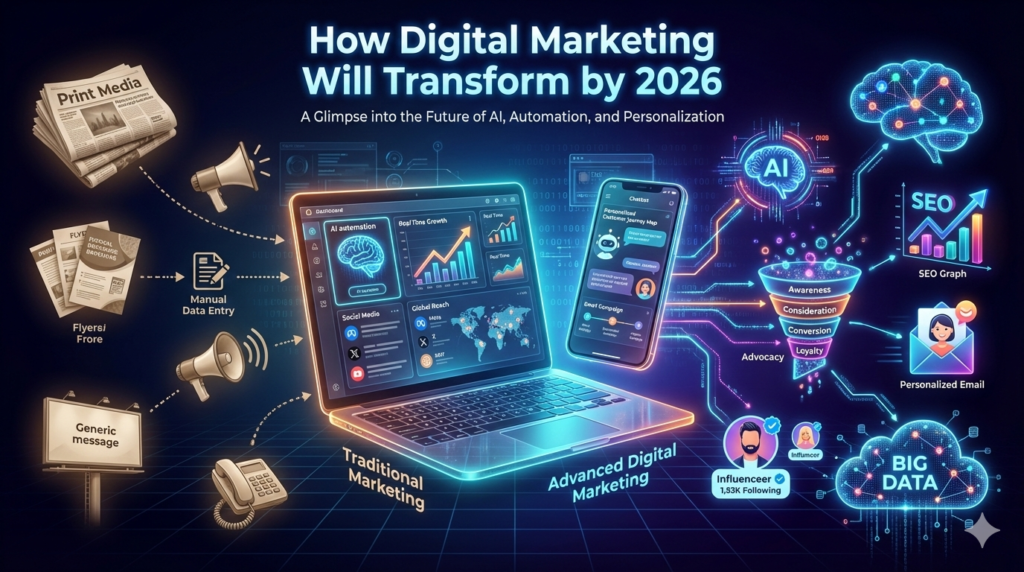
By 2026, digital marketing will become more intelligent, ethical, and customer Priority. Consumers across the US, Europe, Asia, the Middle East, and emerging markets are already demanding meaningful interactions rather than aggressive promotions. Algorithms are becoming smarter, and platforms are prioritizing content that truly helps users.
One of the biggest changes will be the decline of third-party cookies. Brands will rely more on first-party data collected through websites, email subscriptions, and communities. At the same time, voice search, visual search, and conversational AI will change how people discover brands online. Digital marketing in 2026 will focus less on “chasing traffic” and more on building long-term digital ecosystems.
AI-Powered Marketing: The Backbone of 2026 Strategies
Artificial Intelligence will not replace marketers, but marketers who use AI will replace those who don’t. In 2026, AI will play a central role in almost every digital marketing activity. From content creation to ad optimization and customer support, AI will enable businesses to operate at a global scale with precision.
AI-driven tools will analyze customer behavior patterns across regions, helping brands deliver personalized experiences in different languages and cultures. Predictive analytics will forecast buying behavior, allowing marketers to launch campaigns at the right time for the right audience. AI chatbots and virtual assistants will provide 24/7 customer support across time zones, improving customer satisfaction worldwide.
The key to success will be balancing AI efficiency with human creativity. Brands that use AI to enhance authenticity—not replace it—will stand out in 2026.
Content Marketing in 2026: Global, Personalized, and Value-Driven
Content marketing will remain one of the strongest pillars of digital marketing in 2026. Normal content will no longer perform well in a competitive global environment. Audiences want relevant, personalized, and culturally aware content.
For global targeting, businesses will focus on localized content strategies. This doesn’t mean simple translation—it means adapting tone, examples, and context for different regions. Educational content, problem-solving blogs, and experience-based storytelling will outperform promotional content.
Short-form videos will dominate platforms like YouTube Shorts, Instagram Reels, and TikTok, while long-form blogs and podcasts will continue to build authority. The winning strategy will be content that educates, inspires, and builds trust across borders.
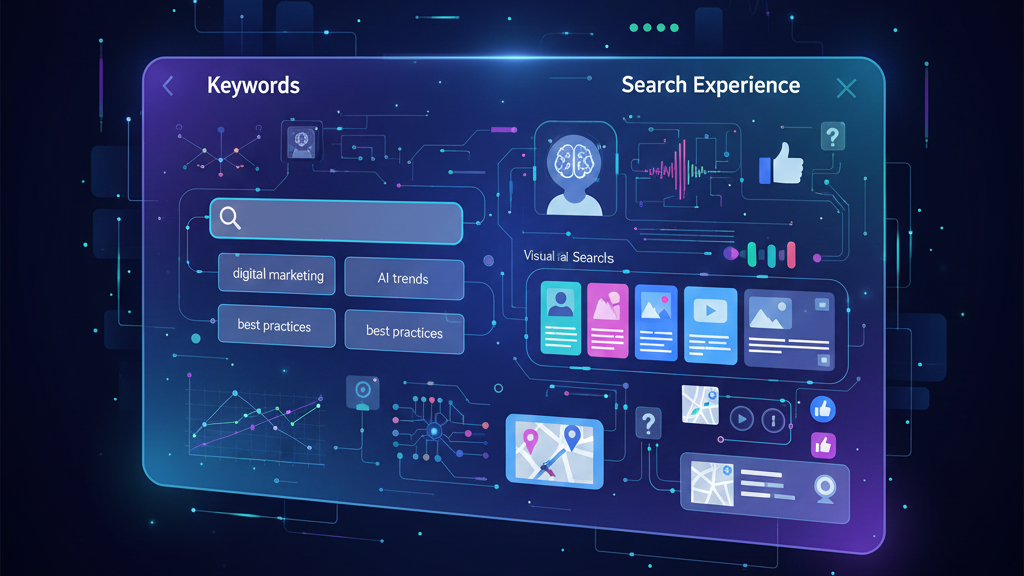
SEO in 2026: From Keywords to Search Experience
Search Engine Optimization in 2026 will go far beyond keyword placement. Google and other search engines are already prioritizing Search Experience Optimization (SEO), which focuses on how users interact with content rather than just ranking signals.
Voice search and conversational queries will grow significantly as smart assistants become more common globally. Visual search will also expand, especially in e-commerce and lifestyle niches. Websites that load fast, are mobile-friendly, and offer a seamless user experience will out perform competitors.
Experience, Expertise, Authority, and Trust—will remain crucial. Brands must show real expertise through original insights, case studies, and credible authorship. For global SEO, proper international targeting, multilingual structure, and region-specific optimization will be essential.
Social Media Strategy for a Global Audience in 2026
Social media in 2026 will focus more on community-building than follower counts. Algorithms are increasingly rewarding meaningful interactions, not vanity metrics. Brands that create loyal communities will enjoy higher reach and stronger brand recall.
Social commerce will continue to grow globally, allowing users to discover, research, and purchase products directly within platforms. Influencer marketing will shift toward micro and nano influencers who have higher trust and engagement within niche communities.
Risk will go very down where as profit increase in coming future. Depending on a single platform is risky. Successful brands will maintain a presence across multiple platforms while tailoring content to each audience’s preferences and cultural context.
Paid Advertising and Performance Marketing Trends
Paid advertising will remain an essential growth channel in 2026, but the approach will change significantly. AI-driven ad platforms will automate targeting and creative optimization, making campaigns more efficient and data-driven.
With privacy regulations expanding worldwide, marketers will rely more on contextual targeting and first-party data. Omnichannel advertising strategies will become More, integrating search, social, video, and native ads into a unified customer journey.
The focus will shift from short-term conversions to lifetime customer value, ensuring sustainable growth across global markets.
Email Marketing, Automation, and CRM in 2026
Despite being one of the oldest digital channels, email marketing will still be very effective in 2026, especially when it is combined with automation and AI. Emails that are personalized based on a user’s behaviour, interests, and location will perform much better than generic mass emails.
Automation will allow brands to nurture leads automatically at a large scale while still keeping messages relevant. AI-powered CRM systems will help businesses understand the full customer journey and deliver a consistent experience across all touchpoints. For global audiences, brands will also customize emails based on time zones and cultural preferences, which will lead to higher engagement and better conversions.
Data Privacy, Ethics, and Brand Trust

Trust will be the most valuable digital currency in 2026. With stricter data protection laws such as GDPR and other global regulations, brands must adopt transparent and ethical marketing practices.
Consumers want to know how their data is used. Clear consent, honest communication, and responsible AI usage will strengthen brand credibility. Ethical marketing will no longer be optional—it will be a competitive advantage.
Brands that prioritize privacy, fairness, and authenticity will earn long-term loyalty and global recognition.
Building a Future-Ready Digital Marketing Strategy for 2026
To succeed in 2026, businesses must start preparing today. The foundation of a strong digital marketing strategy lies in adaptability. Regular audits of digital performance, investment in AI tools, and continuous learning will be essential.
Marketers must focus on customer experience at every stage of the journey. Training teams in future skills, experimenting with emerging platforms, and staying updated with global trends will help brands stay ahead of the curve. A flexible, data-driven, and ethical approach will define successful digital marketing strategies in 2026.
Conclusion: The Future Belongs to Adaptive Brands
Digital marketing in 2026 will be smarter, more human, and more global than ever before. Businesses that embrace AI, prioritize trust, and focus on meaningful customer experiences will thrive in this evolving landscape. The future does not belong to the biggest brands—it belongs to the most adaptable ones.
Start building your 2026 digital marketing strategy today, and you’ll be ready to lead tomorrow.
FAQs – Digital Marketing Strategy for 2026
1. What is the most effective digital marketing strategy for 2026?
A strategy that combines AI, personalization, strong content, ethical data usage, and customer experience will be the most effective.
2. Will AI completely replace digital marketers in 2026?
No. AI will enhance productivity, but human creativity, strategy, and emotional intelligence will remain essential.
3. Is SEO still important in 2026?
Yes. SEO will evolve into search experience optimization, focusing on quality, trust, and user experience.
4. How can small businesses compete globally in 2026?
By using AI tools, focusing on niche audiences, creating value-driven content, and building trust-based communities.
5. What skills should digital marketers learn for 2026?
AI tools, data analysis, content strategy, automation, ethical marketing, and customer experience management.

Pingback: Why Most People Quit Digital Careers: The strong Concept 2026
Pingback: How to Build Authority as a Digital Marketer. #6 Different..
Pingback: Consistency Formula for Digital Success - Mithila Digital...01
Pingback: Why Digital Career Is a Marathon, Not a Sprint | Long-Term..2026