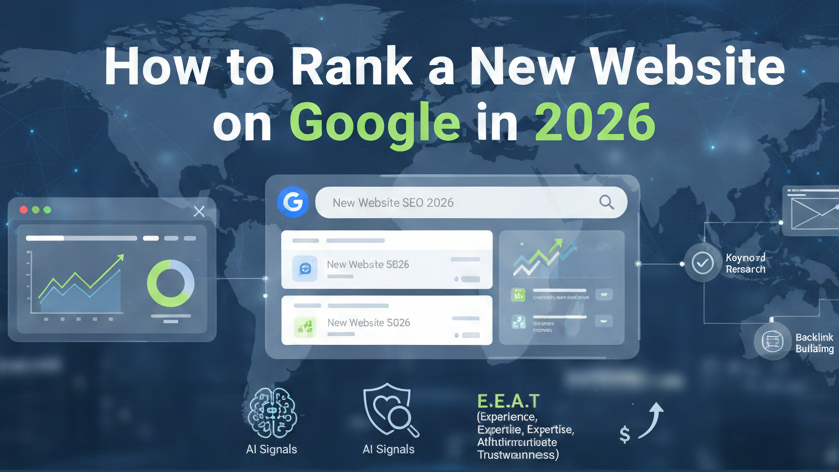
Launching a new website is exciting, but the biggest challenge is getting it ranked on Google. People often think that ranking is impossible without an old domain or heavy backlinks. The reality is that if you work in the right direction, even a new website can rank on Google. In this guide, we will explain step by step how to take a fresh website to the first pages of Google, in a simple and practical way.
Google’s main goal is to provide the best possible answers to users. Therefore, Google does not ignore new websites, it just takes some time to build trust in them. When Google sees that your content is helpful, users are spending time on it and the website is properly optimized, then rankings gradually start improving.
How Google rank new websites.
Google first visits your website, then saves your pages, and then decides where to display them in search results. For new websites, Google is a little more cautious because it doesn’t have any historical data to judge the site. This doesn’t mean Google ignores new websites—it just needs some time to build trust.
When you regularly publish helpful content and improve your website, Google begins to see positive signals that your site is trustworthy. Over time, these signals help your website rank higher on Google.
Keyword Research: Ranking Foundation

If you choose the wrong keywords, even the best content may not rank high on Google. For a new website, it’s important to choose low-competition and specific keywords. Competing on broad keywords like “SEO” or “Digital Marketing” is nearly impossible for beginners.
Instead, you should focus on long-tail keywords like “how to rank a new website on Google” or “SEO tips for new websites.” Such keywords have less competition and clear user intent. Google search suggestions and the “People Also Ask” section are very helpful for keyword ideas..
Content that appeals to both Google and users
Content is the reason Google ranks your website. Simply adding keywords isn’t enough. Your content should be genuinely helpful. Consider whether your article fully answers the user’s search question.
How-to guides, beginner tutorials, and problem-solving articles work well for new websites. When you cover a topic, don’t leave it halfway. Simple language, short paragraphs, and clear explanations make content more effective.
On-Page SEO: Make easy for Google to understand

On-page SEO means clearly telling Google what your page is about. The page title, meta description, headings, and URL structure play an important role in this. If your title and headings are clear, Google can easily understand your content.
Clear and readable URLs, correct heading structure, and internal linking are very beneficial for a new website. These things are important not only for ranking, but also for user experience.
The role of website speed and mobile experience
Nowadays, most of the users visit the website from mobile. If your website is slow or does not open properly on mobile, then users leave the website immediately. Google considers such behavior as a negative signal.
So you should make your website fast and mobile-friendly. Lightweight themes, compressed images and limited plugins can improve website performance significantly. With free tools like Google PageSpeed Insights, you can easily check where your website is slow.
It’s important to let Google know that your website exists.
Simply creating a website doesn’t automatically rank all pages for Google. You need to submit your website through Google Search Console. Submitting a sitemap helps Google discover your pages.
Google Analytics helps you understand which pages are getting traffic and user behavior. This data is very useful in making future SEO decisions.
Backlinks: A Strong Signal For Building Trust
Backlinks are a trust signal for Google. When other websites link to you, Google recognizes that your content is valuable. New websites should gradually build quality backlinks.
You can start with guest posting, business listings, and relevant directories. Purchasing links in the wrong way or using spammy links can harm future rankings.
Local SEO can give faster results

If you’re targeting a specific city or area, local SEO can be a game changer. Creating a Google Business Profile, using local keywords, and collecting customer reviews improve local rankings.
Local searches have less competition, so new websites get results relatively quickly.
Consistency and Patience: The Most Important Factors
SEO is a long-term game. Expecting traffic from a new website in 1-2 weeks is unrealistic. Publishing regular content, keeping your website updated, and following SEO basics are the secrets to success.
Generally, noticeable results begin to appear within 3-6 months, and strong rankings within 6-12 months..
Conclusion: Is it possible to rank a new website on Google?
If you choose the right keywords, write helpful content, and follow basic SEO principles, even a new website can rank on Google. Shortcuts don’t work in this process, but consistency and patience are always rewarded.
Start today, take small steps, and gradually your website will appear higher in Google’s search results.
Q1. How long does it take to rank a new website on Google?
Ans- Usually 3–6 months with proper SEO.
Q2. Can a new website rank without backlinks?
Ans- Yes, for low-competition keywords.
Q3. How many blog posts are needed to rank?
Ans- Quality matters more than quantity.
Q4. Is SEO free for new websites?
Ans- Yes, organic SEO can be done completely free.
Q5. Which SEO is best for beginners?
Ans- On-page SEO and content SEO.